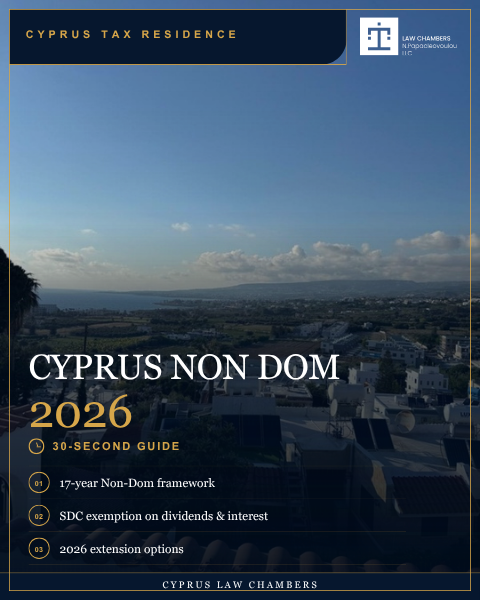
Cyprus Non-Dom 2026: Understanding the Framework Before You Relocate
Cyprus Non-Dom 2026 remains an important part of Cyprus' tax residence framework for internationally mobile individuals, entrepreneurs, investors and families considering relocation to the island. Following the 2026 tax reform, the Cyprus Non-Dom regime continues to form part of the country's wider tax system, but it should never be viewed in isolation or reduced to a headline claim of zero tax.
A well-planned relocation to Cyprus requires consideration of tax residence, domicile, immigration status, income sources, General Healthcare System contributions, banking, property ownership, succession planning and any continuing tax or reporting obligations in another jurisdiction. The correct structure depends on the individual's circumstances and should be reviewed with appropriately qualified tax advisers.
What does Cyprus Non-Dom mean?
Tax residence and domicile are separate concepts. An individual may become tax resident in Cyprus while remaining non-domiciled in Cyprus for Special Defence Contribution purposes. This distinction is particularly relevant to internationally mobile individuals who establish Cyprus as their new place of residence.
The Cyprus Non-Dom framework also contains a deemed domicile rule linked to long-term residence. In broad terms, an individual who has been Cyprus tax resident for at least 17 of the preceding 20 tax years may fall within the deemed domicile provisions. Residence history is therefore an essential part of any Cyprus Non-Dom assessment.
Why the Cyprus Non-Dom framework attracts international residents
For qualifying non-domiciled Cyprus tax residents, the framework can provide favourable treatment in relation to Special Defence Contribution on certain dividend and interest income. This is one reason why Cyprus continues to attract internationally mobile professionals, business owners and investors.
However, Cyprus Non-Dom does not automatically mean that every category of income is free of tax or contributions. Cyprus income tax rules, General Healthcare System contributions, foreign tax, double tax treaties and the nature and source of the income must all be considered separately.
Tax residence comes first
Before Cyprus Non-Dom status becomes relevant, an individual must first consider whether Cyprus tax residence can be established under the applicable statutory tests. For internationally mobile individuals, this can involve reviewing the number of days spent in Cyprus, accommodation, business and employment links, family circumstances and whether another country may also regard the individual as tax resident.
Where two jurisdictions may both claim residence, applicable double tax treaty provisions may also become relevant. For this reason, relocation planning should start before the move rather than after residence has already changed.
Relocation is more than tax
A successful move to Cyprus usually involves several connected workstreams. Immigration status should be addressed so that the individual has the correct legal basis to live in Cyprus. Property arrangements should be reviewed, whether the person intends to purchase, rent or build. Banking arrangements should be organised with a clear documentary source of funds trail. Wills and succession planning should also be considered, particularly where assets or family members are located in more than one country.
Business owners and investors may also need to review company structures, employment arrangements, investment holdings and the timing of transactions before changing residence. These issues should be coordinated with tax and accounting advisers to ensure that the legal and practical arrangements are aligned.
Why Cyprus remains attractive in 2026
Cyprus combines EU membership, an established professional services sector, an extensive double tax treaty network, a recognised Cyprus Non-Dom framework and a Mediterranean lifestyle. For many internationally mobile individuals, the attraction is not one single tax rate but the combination of residence options, professional infrastructure, connectivity, quality of life and long-term planning possibilities.
The decision to relocate should therefore be based on the individual's complete circumstances rather than on a comparison of headline tax rates between countries.
Frequently asked questions
Is the Cyprus Non-Dom regime still relevant in 2026?
Yes. Cyprus Non-Dom continues to be a relevant part of the Cyprus tax residence framework in 2026, subject to the applicable eligibility, residence and domicile rules.
Does Cyprus Non-Dom mean zero tax?
No. Cyprus Non-Dom principally affects the treatment of certain income for Special Defence Contribution purposes. Other taxes, contributions or foreign obligations may still apply depending on the person's circumstances.
What is the 17 out of 20 year rule?
The Cyprus framework contains a deemed domicile rule linked to long-term Cyprus tax residence. An individual's complete residence history should therefore be reviewed before relying on Cyprus Non-Dom treatment.
Should relocation planning take place before moving?
Yes. Tax residence, immigration, property, banking, succession planning and cross-border matters are generally easier to coordinate before the relocation or major transactions take place.
Plan before you relocate
At Cyprus Law Chambers, Nicos Papacleovoulou LLC, we assist with the legal, immigration, property and relocation aspects of moving to Cyprus and coordinate, where appropriate, with specialist tax advisers, accountants, banks and other professional advisers.
Considering relocating to Cyprus? Contact Cyprus Law Chambers to discuss the legal and practical steps involved in your move.
This publication is for general informational purposes only and does not constitute legal or tax advice. Individual circumstances should be reviewed with appropriately qualified professional advisers.