
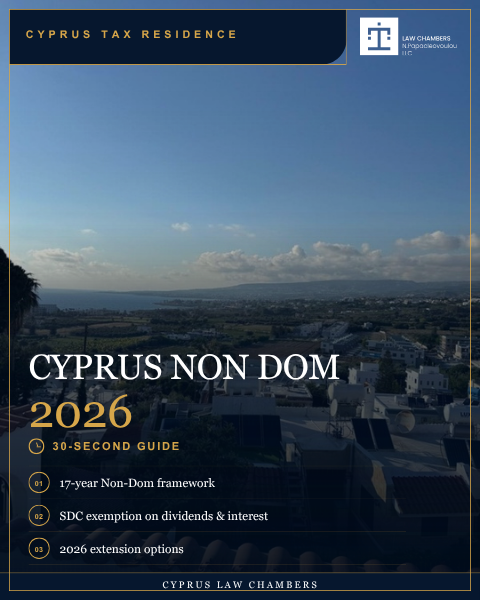
Cyprus Non Dom in 2026: What International Investors Should Know
Cyprus continues to strengthen its position as a European base for internationally mobile individuals, entrepreneurs, investors and families. One of the principal reasons is the Cyprus Non Domicile regime, commonly known as Cyprus Non Dom.
The 2026 tax framework has preserved the core attraction of the regime while also introducing an important extension mechanism for certain long term Cyprus tax residents. The result is a regime that remains highly relevant for people considering relocation to Cyprus, but it must be understood correctly and not reduced to a blanket claim of “0% tax”.
What does Cyprus Non Dom mean?
Cyprus tax residence and Cyprus domicile are separate concepts. A person may become tax resident in Cyprus while remaining non domiciled for Special Defence Contribution purposes, provided the statutory conditions are satisfied.
For a qualifying Cyprus tax resident who is treated as non domiciled, dividend income and passive interest income are generally exempt from Special Defence Contribution. This is one of the principal reasons the regime is attractive to investors, business owners and internationally mobile individuals whose income includes dividends or investment returns.
The exemption should not, however, be described as an absolute zero tax regime. Other liabilities may still arise depending on the nature of the income and the individual circumstances. In particular, Cyprus General Healthcare System contributions may apply to dividends and interest, subject to the relevant rules and annual contribution ceiling.
What changed in 2026?
The standard Cyprus deemed domicile rules are commonly associated with a 17 year period. From 2026, eligible individuals may, subject to the legislation and applicable conditions, elect for an additional five year period and subsequently a further five year period.
The extension mechanism requires an upfront payment of €250,000 for each five year period. This makes the development especially important for individuals who are considering Cyprus as a long term base rather than as a short term relocation destination.
Why the comparison with Germany needs care
Recent commentary has compared Cyprus with Germany by referring to Cyprus Non Dom treatment on dividends and interest and to Germany’s top income tax rates. The broad comparison helps explain why Cyprus can be attractive, but the figures should not be presented as if they tax the same income in the same way.
Germany applies a 45% top statutory income tax rate in 2026 above the relevant taxable income threshold, and the solidarity surcharge may also apply in relevant cases. Cyprus Non Dom, by contrast, is primarily concerned with exemption from Special Defence Contribution on qualifying dividends and interest. A responsible analysis therefore compares the individual’s complete tax position, not only headline percentages.
What should be reviewed before relocating to Cyprus?
A proper relocation analysis should consider where the individual will become tax resident, whether the Cyprus Non Dom requirements are satisfied, the source and type of income, any employment or pension income, capital gains, the relevant double tax treaty, General Healthcare System contributions, existing companies or trusts, and the timing of dividends, disposals or restructuring.
For a person relocating from Germany or another high tax jurisdiction, the tax consequences in the former country of residence must also be reviewed. Cyprus tax planning should not be considered in isolation.
Tax residence is not the same as immigration residence
Holding a Cyprus immigration permit or purchasing property in Cyprus does not by itself determine every aspect of an individual’s tax status. Immigration residence, property ownership and tax residence are distinct legal concepts and should be coordinated carefully.
For individuals and families planning to move to Cyprus, immigration, property acquisition, tax residence, banking, corporate structuring and succession planning are usually best considered as one coordinated relocation project.
Why Cyprus remains attractive
The Non Dom regime is only one part of the Cyprus proposition. Cyprus combines European Union membership, an established legal and professional services sector, a wide double tax treaty network, an English language business environment, residence and permanent residence routes for qualifying applicants, and a geographical position linking Europe, the Middle East and Africa.
The more useful question is therefore not simply “What is the tax rate in Cyprus?” but “How would my complete legal, tax and residency position change if I became resident in Cyprus?”
Frequently asked questions
Is Cyprus Non Dom still available in 2026?
Yes. The regime continues to provide qualifying Cyprus tax resident non domiciled individuals with an exemption from Special Defence Contribution on qualifying dividend and passive interest income.
How long can Cyprus Non Dom treatment last?
The standard deemed domicile framework is commonly associated with 17 years. From 2026, certain eligible individuals may elect for two additional five year periods, subject to the statutory conditions and the required payment for each period.
Are dividends completely tax free for Cyprus Non Doms?
They may be exempt from Special Defence Contribution for qualifying non domiciled individuals. That should not be presented as an absolute zero tax rule because other liabilities, including General Healthcare System contributions and foreign tax considerations, may still apply.
Does buying property in Cyprus make someone tax resident?
No. Property ownership, immigration residence and tax residence are separate concepts. Tax residence depends on the applicable statutory tests and the individual’s factual circumstances.
Can someone moving from Germany use the Cyprus Non Dom regime?
Potentially, yes, where the Cyprus tax residence and Non Dom requirements are satisfied. German exit, residence and continuing tax considerations must also be reviewed independently.
How Cyprus Law Chambers can assist
Law Chambers Nicos Papacleovoulou LLC assists international clients with the legal aspects of relocating to Cyprus, including property acquisition, immigration and permanent residence, relocation planning, legal coordination of tax residence arrangements, banking and documentary requirements, corporate and investment structures, and succession and estate planning.
Where specialist tax calculations or tax opinions are required, the matter should be coordinated with professional tax advisers so that the legal and tax elements of the relocation are considered together.
Planning a move to Cyprus? A properly structured relocation begins before the move itself.
Sources reviewed
This publication was prepared after reviewing current 2026 material on the Cyprus Non Dom extension regime, General Healthcare System contribution rules and the German 2026 income tax tariff, including material from the Cyprus professional tax sector, the Health Insurance Organisation and the German Federal Ministry of Finance.
This article is for general information only and does not constitute tax or legal advice for any particular person. Individual circumstances should be reviewed before action is taken.
